Disenchanted to Meet The Life of a Showgirl
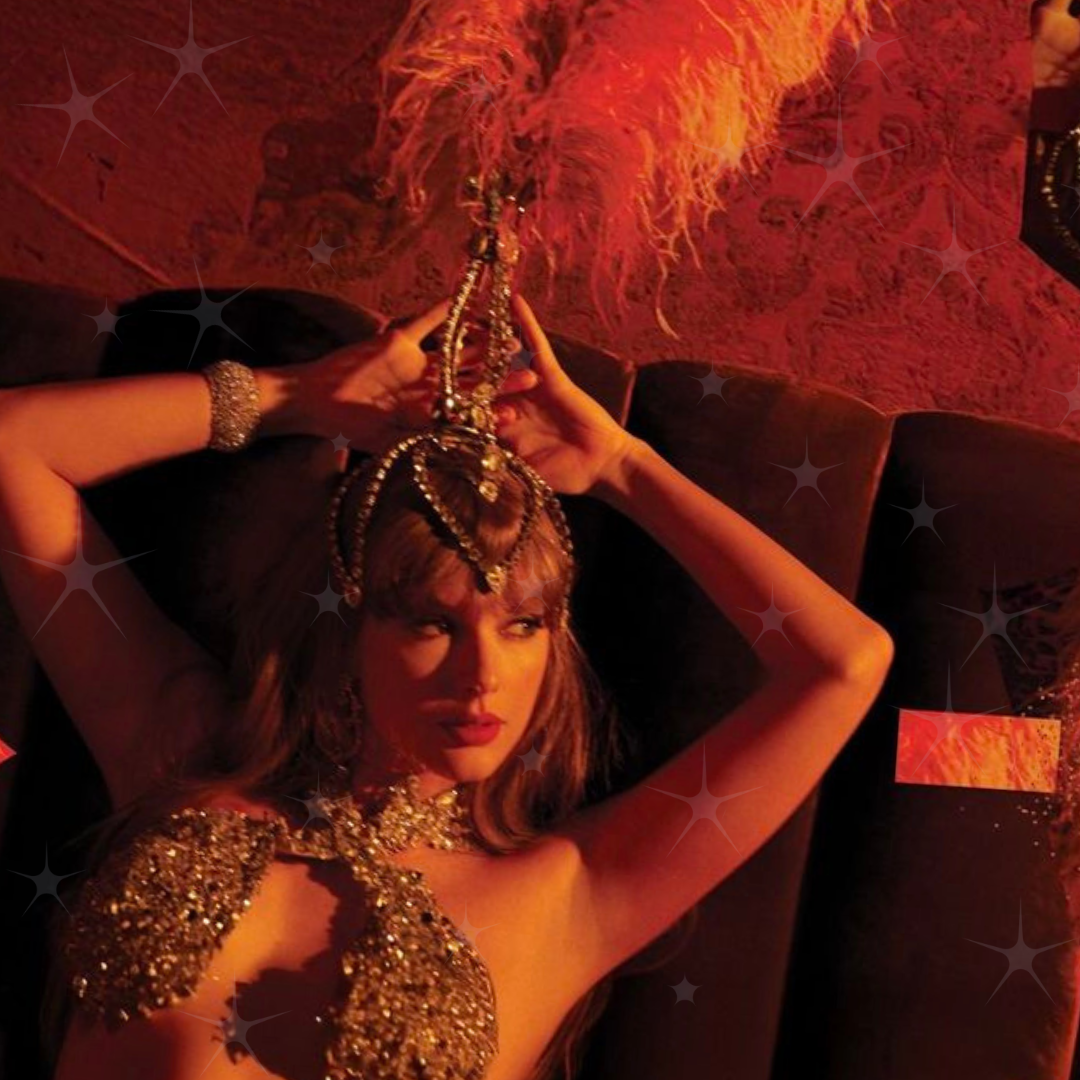
by Nava Bahrampour and Griffin Meyer
Nava’s thoughts:
Disenchantment, a term that the classical social theorist Max Weber popularized in the early 20th century, is an experience brought on by the newfound secularization, bureaucratization and rationalization of the world during the modern era. To put it very simply, it entails a loss of wonder and enamorment accompanied by learning how everything works. When asked by a friend what I thought of Swift’s new release and twelfth studio album, I could not figure out exactly how I felt at the moment. If asked again after further reflection, I would have responded with “disenchanted.” The catapult of energy and even mystery that I’d come to associate with release nights – in other words, my enchantment – was simply absent upon my many listens to Showgirl over release weekend.
What makes this release uniquely confusing, from a fan’s perspective, is that we have seen Taylor Swift excel brilliantly at all of the things that she fails to achieve on Showgirl. Upon hearing a song like The Fate of Ophelia, a rousing up-tempo ode to Travis Kelce rife with background echoes and prechoral suspense, it is hard not to be briefly taken back to the sparkling highs of 1989. The chorus is a pleasant, nostalgic retreat into the past which is all too easily broken with her lyrical pledge of allegiance to Kelce’s “vibes.” Throughout the record, there are similar temporary flicks of brilliance - one can only wish she had run with them for three minutes. The pre-chorus to Wood, melodically and production-wise, for one, is wonderfully positioned within the song and reminiscent of classics past. However, the song is an example of how Swift’s lyricism tends to undercut her musicality in Showgirl; take, for evidence of my claim, the postchorus of the aforementioned track and its arguably infamous lyric, “Redwood tree, it ain’t hard to see / His love was the key that opened my thighs.” Surely, this isn’t the same writer of “Nothing New” off of the Red (Taylor’s Version) vault or of evermore’s “champagne problems.” Additionally, her once-rightful armor and narrative of “Swift versus the universe” is now harder to get behind – there is an ease that comes with rooting for the Swift of 2017’s reputation that is hard to find in songs like “Actually Romantic,” an indie-pop song largely rumoured to be about Charli XCX, who wrote “Sympathy is a knife,” largely rumoured to be about Taylor. For those who have not listened to Brat, “Sympathy is a knife” is Charli’s meditation on her position in an ever-changing, competitive industry and the insecurities that accompany it. Where Swift was once a sympathetic narrator in her musical responses to critics and skeptics, she is now taking the lower road (choosing not to ‘work it out on the remix,’ if you will) in response to Charli XCX’s song, which does not suggest that Swift is an opponent so much as it suggests that she is an extremely accomplished and sought after artist whom others aspire to be like, to the point where she may inadvertently “tap [one’s] insecurities.”
As disappointed and jostled from my amazement at “Taylor Swift, the songwriter” as I feel right now, it is unsurprising to me that this release has given way (and legitimacy) to a collective disdain for Swift’s role in the public sphere right now. We are growing disenchanted with Taylor at the same time as we grow disenchanted with the systems that she has brilliantly maneuvered to her advantage, namely neoliberal capitalism. Swift’s brand of liberalism and “girlboss[ing] too close to the sun,” as she puts it in the reputation-esque pop romper CANCELLED!, feels increasingly ill-suited to our current moment. As a plethora of TikToks have pointed out, our social, political and cultural landscape makes it all the more difficult for us to overlook Swift’s billionaire status coupled with her silence on the most defining human rights issues internationally and domestically, as well as her willingness to ally herself with those who laud and uphold systems of oppression. These symbols of apoliticism in our current landscape not only complicate but contradict the story that she has so skillfully told through her songwriting and previous ten or so releases: that she is just like you, she sees you, and she understands. I say this not as a longtime skeptic but as an enthusiastic Eras tour attendee and willful recipient of Swift’s message to audiences worldwide.
In her recent, nuanced and extremely thoughtful review of the album, Amanda Petrusich, one of my all-time favorite music critics, described the distance between Swift’s prolific business tactics and her desire to position her audience as her friends and closest confidants as a “simulacrum of intimacy.” This characterization resonated strongly with me. I will always cherish the ways that Swift felt like an unfailingly loyal witness to my adolescence, but it is evident to me that my musical relationship with her has changed in the last year or two into one of occasional retreats of nostalgia via 1989 when I need to run quickly to a meeting on the other side of campus or “Nothing New” from Red (Taylor’s Version) when I, too, wonder whether there really comes more wisdom and certainty with age. As I understand Swift’s universe and music differently, I remain appreciative of and nostalgic for my past enchantment but accept that other artists can now evoke—far more powerfully—this feeling for me. Perhaps Showgirl was the final illumination of Swift’s new role in my musical life.
Griffin’s thoughts:
Taylor has released her 12th studio album The Life of a Showgirl, her sixth original record in six years - a fact that never fails to astound me. This is on top of four re-recordings released in the off-years (2021 and 2023). To summarize: we have not had a year without a Swift release in six years.
Adding to this endless surge of content, the international blockbuster Eras Tour took over the pop culture stratosphere from the beginning of 2023 to the end of 2024 - stretching the monocultural capabilities of the music, the fandom, and Swift herself. And… on top of that the first 7 months prior to the Life of a Showgirl announcement were almost uneventful, however this period was upended by the purchasing of the master recordings - which overtook news circuits and social media for a week. All of this to say, Swift has not caught a break. And the cracks in the mirage have never been more obvious than with this album.
I was very much looking forward to this, I can’t lie. In her landmark promotional appearance to announce Showgirl on fiancée Travis Kelce’s podcast New Heights in August, Swift emphasized the focus on melody, production, and a cohesive album. Furthermore, she stated that it would have no more 12 tracks—no bonus or Anthologies or 3am Editions. The big piece of information that sold me was the return of producers Max Martin and Shellback, who collaborated with Swift on the cinematic pop albums 1989 and reputation.
12 tracks, “bangers”, tight lyrics and lively production: all this makes for an anti-Tortured Poets Department, which was anything but. By marketing Showgirl in such a way, it drew the attention of the public, in hopes for a return to form, perhaps a new 1989 - older Taylor edition.
So….what happened here?
On my first listen, I kept expecting a redirect; a course correction to the music I knew, the music I was expecting. But it was nowhere to be found. I find myself doubting whether the marketing influenced my enjoyment of the music. But of course, it did. The “bangers” are very difficult to find in this album, with no potential singles like Blank Space or Style to extend the album’s cultural influence.
Yet, there is also Swift’s musical growth to take into consideration.
Throughout her discography, she has had a penchant for songs with compelling stories, that can relay messages for fans and the general public to make their own interpretations of. As well, she makes songs you can dance to, you can be sad to, and you can enjoy. I’ve been a fan at how her songwriting has stood the test of change of genre or subject skillfully.
In recent years, Swift has grown more acclimated to including more complicated words that don’t easily roll off the tongue as her simpler lyrics. Sometimes, this tactic works, but most times it doesn’t. folklore and evermore were (and are) esteemed in audiences’ eyes for their role in evolving her craft, stretching Swift’s songwriting skills to include storytelling from fictional characters.
She received a ton of criticism, both from fans and critics, for TTPD, which has been amended within this album. The songs on Showgirl arguably do have more variety in production and better reckoning with melody than Tortured Poets ever did. I can’t help it, the Showgirl tracks have gotten into my head. However, with the absence of verbosity comes many lyrics that don’t really say…anything. I can’t think of a song that tells a full story, instead resorting to a montage of imagery or vignettes as songwriting devices. The closest the album comes to that is the first track, and lead single, “The Fate of Ophelia”, “Father Figure”, and the title track, the last track on the album. Still, “The Fate of Ophelia” has been criticized for taking a very inaccurate revisionist take of Shakespeare, formulating the character of Ophelia to be a damsel in distress, with a lack of agency.
There are some glimpses into Swift’s songwriting craft; diamonds in the rough, if you will. One example is “I mind my business, God’s my witness that I don’t provoke it” from the much-aligned “Actually Romantic.” Separated from the track itself, this lyric gives me a hint of wordplay similar to “You made a rebel of a careless man’s careful daughter” from Speak Now cut “Mine”. I know that she is still capable of lyrical strengths, but this album doesn’t show it. Luckily, it appears that the trend of setting too many words to one note has lessened on Showgirl, with each line given a specific rhythm, cadence, and melody. So that’s something!
On the production side of things, I have seen online arguments of plagiarism - such as “Wood” taking elements from “Want You Back” by Jackson 5, or “Actually Romantic” echoing “Where is My Mind” by the Pixies. While there have been prior sound-alike claims of Swift’s music to other artists’, these tracks are the most uncanny in replication. The production of the album hasn’t seemed glaringly off, drawing inspiration from 70’s music for some tracks - an interesting departure from her 80’s and 90’s experimentation in prior albums. One instrumental component that seemed strange to me was the drums. Granted, we did not have any (or many) songs on TTPD with drums, which forbade the songs from truly coming alive (“Guilty as Sin,” a glorious exception). Here, we do hear drums, but what irritated me the most was they didn’t have much dimension and had a similar style on many tracks. I listened to a mashup on Instagram of “The Fate of Ophelia” vocals with the instrumental of 1989’s “New Romantics,” and knew that a unique production style for each song was missing, revealing an flaw of sonic sameness. In addition to the lack of drums, another issue I’ve had on some of Taylor’s songs these days is the lack of peaks and troughs with the melody, lyrics and production. It allows the listener to think “Oh, I’m listening to the chorus” or “This is sonically different, this must be the bridge”. Two examples of this are “Honey” and the title track.
Take 1989’s “Out of the Woods” for example, which has easily distinguished sections. The verses have longer, melodic phrases and mellower production, while the choruses have that explosive feel, and a repetitive, sing-alongable chorus. When the bridge hits (“Remember when you hit the brakes too soon”), you know you’re in for another, exciting section with a unique sonic atmosphere.
Granted, on Showgirl, it’s easier to decipher one section from another. Nevertheless, it falls under the melodic trap, where each section either does not have a distinguishable melody, or is similar to the other sections. The bridges on this album are not anything to write home about, with special focus of the composition given to the choruses. A lone bright spot is “Eldest Daughter,” which has a multitude of other issues, like referencing Gen Z slang, but has a memorable bridge ending with “‘Cause I thought I’d never find that beautiful, beautiful life that shimmers that innocent light back when we were young”. Why couldn’t the rest of the album be as humble as this line?
In addition, before I forget, Jack Antonoff and Aaron Dessner are absent from this album, after being key collaborators for the past several years (including the re-recordings). Yet, upon repeated listening, it feels as if Swift doesn’t shy away from the Antonoffian techniques of production, specifically in the case of “Wi$h Li$t” and “Honey”, with utilize a repetitive computerized drum line, and synthesized piano. This classification of Swift’s sound by producers feels superficial, as it lessens her control of musical identity throughout her catalog. A strength (and fault) of her catalog is the constant reinvention, where every album has a different sound, and everything feels like her.
Maybe Swift won’t achieve the cinematic highs of 1989 for a while (if ever). In my blog post regarding the Taylor’s Version eras, one of my main hopes was that Swift would work with Max Martin and Shellback again to recapture the magic. Yes, there were doubts in my mind that she would repeat herself. After all, each album sounds different. However, there is a lack of a true upbeat drive to anchor the atmosphere, and If she can’t even get it right with the original producers, can it ever be possible? Swift notes that she wanted to feel as proud of this album as the Eras Tour, and I just don’t see that.
For such a highly anticipated album by arguably the most popular artist to receive this level of polarization and critical attention, it seems incredibly disorienting especially when it felt like all the stars aligned. This is strange, given that this album hardly described what was occurring behind the curtain, instead repeatedly drawing on Swift’s current romantic life. We are left with only two songs across albums that represent the Eras Tour: “I Can Do It With A Broken Heart,” and “The Life of A Showgirl.” While the former’s lyrics are about overcoming heartbreak and hiding emotional turmoil on stage, the latter deals with the acceptance of the “showgirl” style, with Taylor singing “wouldn’t have it any other way”.
To me, this gives the feeling that many chapters of the story have been ripped out of the book. What about the joy? The feeling of seeing thousands of people wearing LED bracelets singing the songs she wrote when she was a teenager? The Eras Tour behind-the-scenes documentary is set to release next month, but it would have been wonderful to receive a glimpse of this globe-trotting exhilaration in musical form.
All in all, The Life of a Showgirl is lacking, lyrically and conceptually. Perhaps the artistic growth of folklore and evermore were merely happy accidents, guiding the way for a more commercialized, less lyrically strong Swiftian catalogue. As she reaches her way back into pop music, I do hope Swift continues to evolve, but in the right direction. Her lack of underdog status should not lead to excessive references of glamor and prestige, because the large majority of her listeners are normal people, holding on to the songs wherein Swift relays universal emotion and spins a story that only she can tell so well.
As such, we are holding out hope for Swift’s 13th album, colloquially known as TS13. When it arrives, it will answer the question: are we able to explore the woods with her once again? Or will we forever be disenchanted?